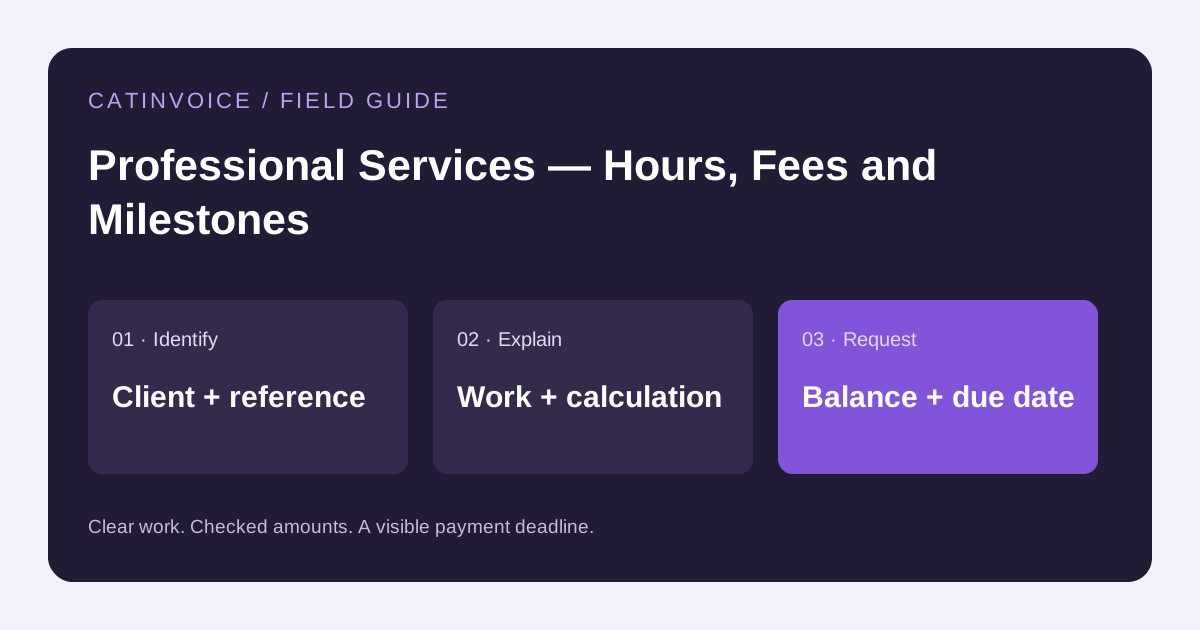
A professional-services invoice should let the client match each charge to an approved task or deliverable. Include the project, service period and purchase-order reference where required, then use the billing units agreed in the proposal.
Hourly services
Describe the work and period, then show hours multiplied by the agreed rate. For example, 6 consulting hours at $100 is $600. Reference a timesheet if the client requires one, and separate non-billable time from the invoiced hours.
Fixed deliverables
Use one deliverable or milestone as the quantity. A $900 report is 1 × $900; its included research hours should not also be charged as separate hourly work. Identify the delivered version or milestone so the approver knows what they are paying for.
Scope changes
Describe additional work separately and reference the client's approval. A new request is not automatically an approved charge. If the price has not been agreed, resolve it before placing an unexplained extra on the invoice.
Retainers and expenses
State the period and services the retainer covers. Reconcile prepaid work before requesting more money. For reimbursable expenses, use the agreed charging basis and retain receipts. Expenses paid directly by the client are not also amounts owed to you.
A checked example
A fixed report at $900 plus 2 additional approved consultation hours at $100 totals $1,100. A $300 deposit already received leaves $800 to pay. This fictional example excludes tax and discounts. Use your actual agreement, currency and applicable tax treatment.
Approval and delivery
Include a unique invoice number, issue date, due date, contracting client, project reference, line items and payment instructions. Export the PDF, send it to the billing contact and include supporting records through the client's accepted channel. Keep a copy and record payments against the same invoice number.
Prepare and keep your invoice
Create an invoice or choose an editable layout from the template library. Replace the sample details, check the preview and download the PDF. Send it using your own email, with supporting documents as separate attachments where needed.
See payment terms and due-date examples and the invoice tracking guide for the next steps. Save the PDF and a backup of any locally stored records.